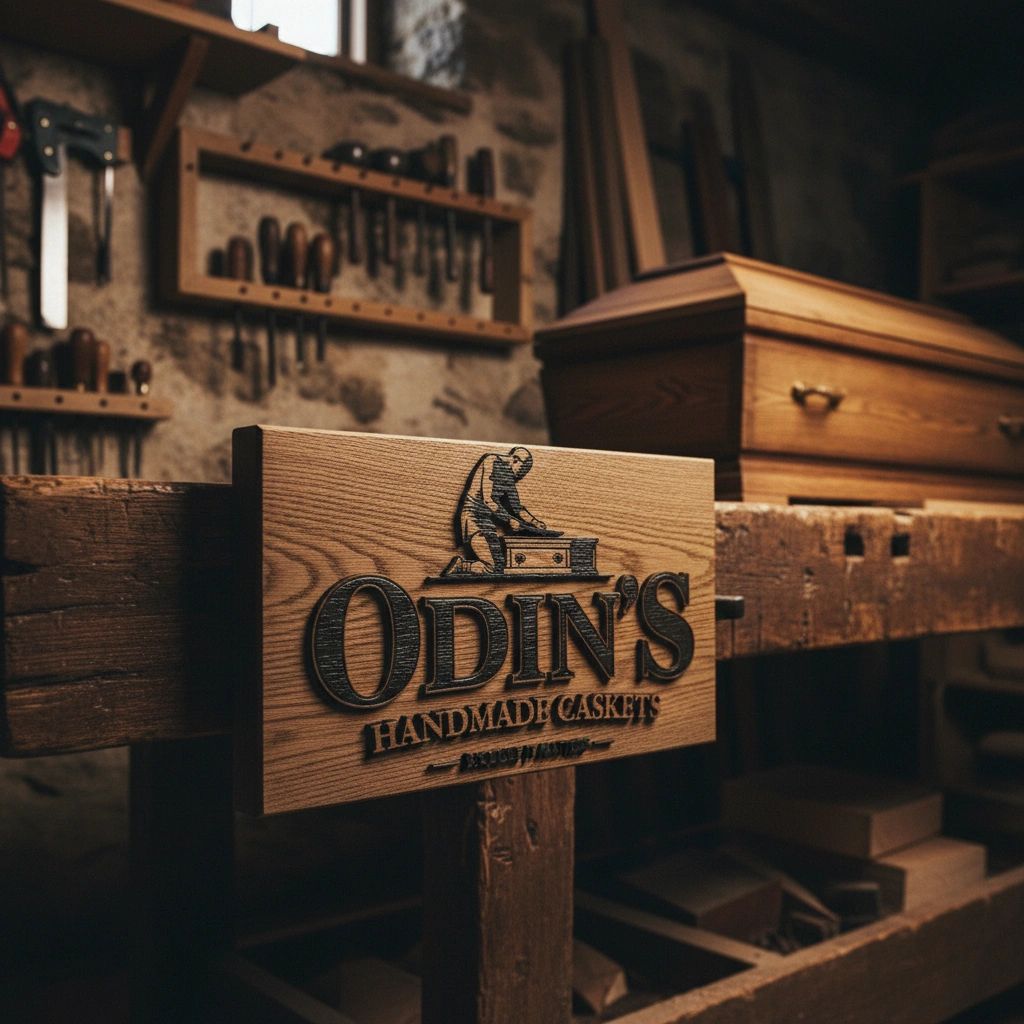
All of our caskets are handmade
Interiors are all natural cotton duckcloth
It takes 10 people days to create just one casket
Finishes are hand rubbed natural oil, burnished with cotton to a soft luster, aged to reflect the life of the person it honors


How we started
Why our caskets matter
Odins’s Handmade Caskets began with a phone call from my daughter, Brianne, who works as a funeral director. I had recently retired from the brand development business and had spent years building furniture, so when she asked, “Can you make a casket and deliver it in six days?” I answered: “Of course, what’s a casket?” For the next hour, she explained the world of caskets and the funeral industry—far more than I could absorb in one conversation. Just before we hung up, she said: “And by the way, it has to be a better casket, or I won’t sell it.” So I asked the obvious question: “What exactly makes a better casket?” Her answer was short “I don’t make caskets. You need to figure that out.”
Brianne often talked about how fortunate she felt to work with people she trusted—people with strong values who truly cared for the families they served. I knew I had a lot to learn. If I was going to offer a casket she could stand behind, it had to be something families could trust as well.
Over the next six months I talked with funeral directors, families, and casket makers, and spent hundreds of hours researching anything I could find. The first article I read shaped everything that followed. It was written by someone who exhumed graves and relocated remains. He described what he found. Some caskets were only 30 years old and had already fallen apart long before the wood itself had decayed. Others were more than a century old and, though clearly aging, were still holding together. His research pointed to one major reason: modern caskets often rely heavily on iron staples. They create a strong connection at first, but over time they rust, fail, and allow the sides to come apart. He ended the article with a simple question: does it really matter when something is buried six feet underground? The more I thought about it, the more certain I became that it did. If it were someone I loved, it would matter to me. When I asked Brianne whether it mattered to families, she said it rarely came up—but if people knew, many of them would care deeply.
As I worked through those questions, I kept thinking about my Norwegian grandfather, who taught me woodworking. We started with a simple shoe rack, which I sold around the neighborhood. He used to tell me, again and again, that nothing would ever be perfect—but it always had to be the best I could do. One day, probably because I thought that standard sounded like too much work, I asked him why it always had to be my best. He paused for a long moment, and I knew an important answer was coming. He looked at me and said, “Because it matters, that’s all.” Somehow that was enough. I understood him then, and I still do. It may be why I became a bit of a perfectionist.
Those moments—the conversation with my daughter, the months of research, and the lessons my grandfather left me—set me on the path that led to the caskets we offer. We build one in solid cherry and another in solid pine. Nothing we make comes from a factory. It takes eleven person-days to complete just one. These are some of the details that matter most to us:
The sides — Look closely at the connections and you will see the ¼-inch dots. Those are wooden dowels, hammered into drilled holes. They will hold until the wood itself returns to the earth. We do use iron where strength calls for it—handles and hinges, for example—but never in places that would weaken the structure over time. The sides are built with solid raised panels that help prevent expansion and cracking during storage. They also give the casket an elegant look while making it remarkably sturdy.
The top — For the lid, we reserve long, hand-selected boards with straight grain. The shorter pieces used in the raised panels come from boards with small natural inconsistencies—details that add character.
The bottom — We reinforce the bottom in three different ways. Most caskets are tested to 550 pounds, which is entirely adequate. We tested our prototype with 1,000 pounds of bricks. We ran out of bricks, but we know it will handle at least 1,000 lbs.
Handle hinges — There are two common ways to attach handles: with surface-mounted wood screws or with bolts that pass all the way through the side. Handles breaking loose are uncommon, but it can happen. We chose the bolt-through method because it makes that kind of failure impossible. Because each casket is handmade, families can also choose the metal finish they prefer. The hardware on display is stamped in the USA by General Manufacturing and Machine Company in Chicago.
Gloss swingbar handles on the display casket — In a box stored inside an old brick building where Pratt & Whitney once made the Wasp engines that helped transform American aviation in the 1930s, were the original dies from 1928 for these Art Deco handles. We were able to acquire the rights to use them, and that history is now part of this casket as well.
Hardware — The hinges, latches, and top supports come from Irion City Stamping in Tennessee. Everything we use—except the fabric weaving—is made in the USA. We believe that matters.
Upholstery — We considered two options for the interior: white or colored crepe, and natural unbleached cotton. Once we learned that crepe is often made from plastic-based polyester, often imported, and may never fully decompose, the choice became clear. We decided to use only unbleached cotton duck cloth. Its natural tone gives the interior a simple, elegant finish, and our seamstress carefully sews each one by hand. Most of the worlds cotton is grown in China, and because of well-documented concerns about child labor harvesting cotton in Gansu Province, we made sure we use cotton sourced from other locations.
Handles — For the wooden handles, we use only select boards with straight grain, much like the wood chosen for baseball bats. While breakage is rare, we make sure there are no knots that could weaken the handle.
Finish — We chose not to use a glossy spray-on finish on any casket we
make. Instead, we use a hand-rubbed antique finish, aged to reflect the life of the person it honors. We begin by dyeing the wood and then wiping the color back. Next, we apply natural oil by hand and complete the surface with a topcoat burnished with cotton to a soft luster. It is a slower process, the same basic approach English carpenters used in the 1600s, but we believe the result is stunning and worth every bit of the effort.
That, in the end, is the story of our six-month journey to offer this casket.
Oh yes, why do we call ourselves Odin’s Handmade Caskets when none of us is named Odin? Odin was my grandfather’s name. We chose it because we did the best we could—and because, as he taught me long ago, it matters.
The Miner
Solid pine with Art Deco handles
Natural Unbleached Cotton Duckcloth
Hand-rubbed antique finish, aged to reflect the life of the person it honors

Unnamed so far
Classic Cherry Casket with Swingbar Handles
Natural Unbleached Cotton Duckcloth
Hand rubbed, natural oil burnished by hand to a natural luster


Contact Us
Phone 406-465-4727
I may be in my shop with loud equipment so leave a message and I will call you right back
Or email Bob@Odinshandmadecaskets.com